
Small and medium-sized businesses (SMBs) are crucial to the global economy through driving employment, innovation and gross domestic product (GDP) growth. Yet, many still face persistent challenges like limited access to capital, increasing competition and the complexity of adopting new technologies. The emergence of additional digital platforms and alternative data sources is opening new possibilities for banks to better serve this vital segment.
In this next deep dive into the 10 key influencers shaping payments this year, advisors from Visa Consulting and Analytics (VCA) explain how new models, powered by financial, transactional and behavioral data, can drive inclusive, scalable and responsible growth for SMBs globally.
The untapped potential of SMBs
Despite their importance, many SMBs remain underserved by the traditional banking community and, often, the barrier is limited and fragmented data.
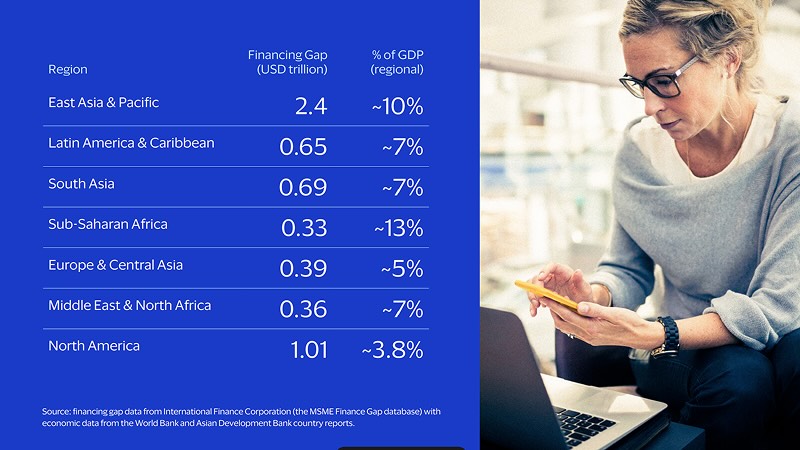
As the chart below demonstrates, SMBs face a considerable financing gap, or a large shortfall between the capital they need to grow and the funding they can access.
The scale of the SMB community’s economic contribution and the extent of the financing gap
Data as the new currency: Unlocking value beyond lending
As digitalization accelerates, data is becoming as valuable as traditional currency for credit card issuers and other financial institutions serving SMBs. Data-driven insights are revolutionizing credit risk and lending, creating new business models, revenue streams and customer value, with forward-thinking players combining traditional data, alternative data and behavioral data to address local challenges.
SOURCE 1
Traditional data
- Company data (including firmographic data)
- Financial statements and tax returns
- Bank statements
- Credit bureau records (limited coverage in less mature markets)
- Collateral documentation
SOURCE 2
Alternative data
- Mobile phone metadata (e.g., call patterns, location, SMS)
- E-commerce sales data
- Digital wallet transactions
- Utility and rent payment histories
- Payment transaction data
- Banking relationship data
- Cashflow data
SOURCE 3
Behavioral data
- App usage patterns
- Business reviews on social media
- Customer feedback and engagement

To better serve SMBs, banks should consider adopting a holistic, lifecycle-driven data approach. This involves treating data as a dynamic resource that enhances every interaction and decision throughout the SMB journey. Leading banks are already using cohesive data strategies to drive deeper engagement, smarter risk management and sustainable growth.
A key shift involves integrating internal data silos, particularly uniting issuing and acquiring data. Traditionally, banks have treated these data sets separately. A unified perspective allows for more accurate modeling of working capital needs and identification of trends. By understanding both sides of the SMB’s financial equation, banks can offer timely, relevant credit lines and tailored payment solutions.
Inclusion is a component of many modern data strategies. Traditional credit models often exclude newer or thin-file SMBs. But banks can now use alternative data from e-commerce, utility payments, payroll records and social media to get a fuller picture of a company’s health. This broadens access to financing and helps identify high-growth clients.
Rich data and predictive analytics are the next steps in data-driven SMB banking. With updated datasets, banks can anticipate business needs, analyze transaction patterns and suggest actions like seasonal loans or payment term reviews. Embedding these insights into workflows helps timely and relevant interactions.
Personalization, powered by real-time data, is key to best-in-class SMB banking. Banks can offer instant, pre-approved offers, automate cash flow advice and provide industry-specific insights. Combining digital self-service with human expertise helps relationship managers have the same real-time insights as clients, enhancing satisfaction and loyalty.
Forward-thinking banks are embracing data-sharing partnerships with fintechs, payment processors and digital business platforms. These collaborations provide access to new data sources and enable the creation of integrated solutions for SMB needs. Secure, consent-based data sharing can accelerate onboarding, streamline compliance checks and support collaborative risk models. These partnerships can extend the bank’s reach and foster innovation and ecosystem value creation.
Understanding the SMB lifecycle: A framework for value creation
Unlocking the full value of SMB banking requires a shift from viewing customer relationships as a series of isolated transactions to understanding them as a continuous, evolving journey. By adopting a lifecycle perspective, banks can identify and leverage critical moments where data can transform both customer experience and business outcomes.
SMB banking value is maximized by shifting from transactional views to a lifecycle perspective, using data at each stage to improve risk, product fit and customer experience, for example:
Data-driven innovations: The future of SMB banking
The future of SMB banking is being shaped by a spectrum of data-driven innovations. Banks seeking to unlock new value must navigate these opportunities with a clear understanding of their readiness, the investment required and the potential strategic impact. Below, we outline a structured framework, ranging from ideas that can deliver quick wins to those demanding a bold, long-term vision.
Immediate differentiators
Low-to-moderate investment, fast returns
Initiatives involving the use of pre-existing data assets and tools, which typically require minimal overhaul to core systems, offer banks a way to differentiate in the near-term while also building foundational capabilities for the future.
-
-
Banks can use artificial intelligence (Al) and advanced analytics to turn transactional and behavioral data into personalized experiences such as real-time, pre-approved credit offers, dynamic pricing or a dynamic credit line. By deploying customer data platforms and integrating front-line systems, banks can help ensure every client interaction is informed by the latest insights.
-
-
Implementing predictive models allows banks to anticipate SMB needs such as a spike in working capital requirements or signs of financial stress. Prescriptive analytics can then recommend 'next best actions' for both the bank and its SMB customers, driving higher retention and wallet share.
-
-
Providing SMB customers with holistic dashboards, drawing on payment, sales, and banking data, empowers them to monitor and manage their business in real time. For banks, this not only deepens engagement but also generates valuable data on customer behaviors and pain points.
Medium-term transformations
Moderate-to-high investment, strategic impact
These initiatives require more significant investment in data infrastructure, partnerships and cultural change. Yet they represent a step-change in how banks serve SMBs and how they operate internally.
-
-
High-quality, relevant data is crucial for any data-driven strategy. For banks serving SMBs, this means looking beyond traditional financial statements and credit histories. Consent-based data sharing, enabled by open banking, allows SMBs to securely share data from accounting platforms, payment processors or e-commerce systems. This helps banks build a richer understanding of business health and implement intuitive, transparent consent management layers.
-
-
Banks can integrate into digital ecosystems like enterprise resource planning (ERP) platforms, marketplaces, and logistics through data-sharing partnerships. Access to operational data enables embedded finance solutions such as inventory-linked working capital, instant marketplace settlements, and ERP-embedded invoice financing. By targeting key verticals and partnering with platforms, banks can replicate successful models like Shopify Capital. This requires lightweight API integrations and a modular product design approach, positioning the bank as a value-added partner in SMS operations.
-
-
As banks aim to enhance SMB engagement, the traditional model of human advisors manually interpreting data is becoming outdated. The future lies in Al-powered Relationship Management Agents that not only provide insights but also make decisions and take actions on behalf of relationship managers (RMs). These Al agents integrate data from various sources to act in real time, enabling proactive engagement. They can handle tasks like sending tailored emails, scheduling tollow-ups, launching pre-approved offers, and alerting RMs only when human intervention is needed. This allows RMs to focus on advisory roles while Al manages analysis and execution. With proper governance, Al-powered RM agents can deliver faster, more personalized, and consistent engagement, unlocking new value across the SMB lifecycle.
Frontier innovations
High investment, long-term vision
While short- and medium-term data strategies can deliver measurable improvements in how banks serve SMBs, the most transformative opportunities lie in reimagining the role of data itself, not just as an input for decision-making, but as a strategic asset that powers entirely new business models. These long-term ideas require bold investment, regulatory collaboration and a willingness to shape emerging ecosystems. Yet, for banks that lead, they offer the potential to unlock exponential value from the SMB segment.
-
-
Smart contracts represent a fundamental shift in how financial agreements are carried out. By embedding logic into blockchain-based contracts, banks can help SMBs automate complex, multi-party transactions such as milestone-based lending, escrow services, or supply chain financing. The key enabler here is trusted, real-time data: banks act as oracles, feeding verified information (e.g., delivery confirmations, invoice approvals) into smart contracts to trigger execution. This transforms data from a passive record into an active agent of value transfer. It helps reduce friction, eliminates manual reconciliation, and builds trust in high-stake B2B interactions.
-
-
Cross-border payments remain one of the most data-intensive and inefficient processes in banking. Stablecoins offer a compelling solution by enabling instant, low-cost global transfers. But the real opportunity for banks lies in the data layer that surrounds these transactions. By capturing and analyzing payment metadata, compliance signals, and FX trends in real time, banks can offer value-added services such as dynamic FX pricing, automated liquidity management, and embedded compliance. The key consideration for banks is to build the data infrastructure that makes these networks safe, transparent, and value-generating.
How VCA can help: From quick wins to strategic reinvention
Banks should view the ideas outlined above not as a linear roadmap, but rather as a portfolio of innovative pathways. Immediate differentiators can be launched quickly to deliver value and build momentum. Medium-term transformations lay the groundwork for sustainable competitive advantage. Frontier innovations, while requiring vision and partnership, set the stage for the bank’s future role as a data-centric ecosystem leader.
Forward-looking statements
This content may contain forward-looking statements within the meaning of the U.S. Private Securities Litigation Reform Act of 1995. Forward-looking statements generally are identified by words such as “believes,” “estimates,” “expects,” “intends,” “may,” “projects,” “could,” “should,” “will,” “continue” and other similar expressions. All statements other than statements of historical fact could be forward-looking statements, which speak only as of the date they are made, are not guarantees of future performance and are subject to certain risks, uncertainties and other factors, many of which are beyond our control and are difficult to predict.
Third-party logos
All brand names, logos and/or trademarks are the property of their respective owners, are used for identification purposes only, and do not necessarily imply product endorsement or affiliation with Visa.
As-Is Disclaimer
Results presented in this case study may vary, are not claimed to represent typical results and are not intended to represent or guarantee that anyone will achieve the same or similar results. Case studies, comparisons, statistics, research, and recommendations are provided “AS IS” and intended for informational purposes only and should not be relied upon for operational, marketing, legal, technical, tax, financial or other advice. Visa neither makes any warranty or representation as to the completeness or accuracy of the information within this document, nor assumes any liability or responsibility that may result from reliance on such information. The Information contained herein is not intended as investment or legal advice, and readers are encouraged to seek the advice of a competent professional where such advice is required.
These materials and best practice recommendations are provided for informational purposes only and should not be relied upon for marketing, legal, regulatory, or other advice. Visa is not responsible for your use of the marketing materials, best practice recommendations, or other information, including errors of any kind, contained in this document.