Every day, millions of people around the world swipe, tap or click to pay — and expect that transaction to be processed instantly and securely. Behind that split-second transaction is Visa’s network processing up to 83,000 transaction messages per second worldwide. This isn’t just about speed. It’s the result of decades of investment in technology infrastructure, built to uphold trust and ubiquity on a global scale.
Technology matters fundamentally in payments. And nowhere is that philosophy more tangible than in Ashburn, Virginia, home to one of Visa’s most secure and advanced data centers and where the foundation for the future of payments comes to life. I recently visited our Ashburn data center, and I am excited to provide a behind-the-scenes look at the team and the technology that helps keep our network running.
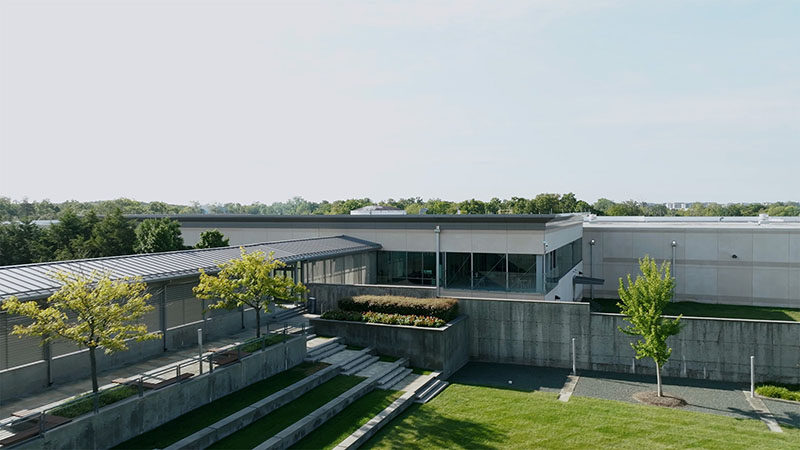
Only 75 of Visa’s employees worldwide are cleared to enter the secure data halls of Ashburn. Inside, you encounter not only the backbone of our network but also the embodiment of Visa’s technology leadership. Spread across 44 acres, Ashburn is built to run commerce for more than 200 countries and territories — 24 hours a day, 365 days a year. This is literally where the world’s money moves.
The foundation of digital payments: Trust and ubiquity
Imagine buying a cup of coffee. By the time the barista hands you your macchiato, your transaction has already traveled the globe — into Visa’s systems, across routers, firewalls and mainframes — and returned authorized or declined in milliseconds. To achieve this speed and security, Visa has architected our systems around four technology pillars:
Scale: Our network spans more than 150 million merchant locations and 4.8 billion credentials globally. Here, we process 322+ billion transactions annually, enabling more than $16 trillion in payments volume each year.
Reliability: With seven independent data centers, our systems run at 99.9999 percent uptime, supported by full redundancy.
Speed: Transactions race through telecom lines, compute systems, storage, networks and security devices like firewalls in mere milliseconds — fast enough to keep commerce flowing without interruption.
Security: From 120+ cyber controls to White House-level physical security, trust is woven into every layer of our infrastructure.
Where the world’s money moves: The physical network
Ashburn’s physical site is engineered for resilience: 18-inch concrete walls withstand 170 mph winds, while multi-layer biometric authentication prevents unauthorized access. The roof alone, 24 inches thick and 8.5 acres wide, is designed to hold more than 20 feet of snow (more than Ashburn will ever get).
The infrastructure supporting this site includes 500 petabytes of stored data powering analytics and fraud detection and 14,000 cables installed annually — the equivalent of 65 miles of wiring.
Visa’s digital defense is formidable, with 22 billion security events monitored every day. Our infrastructure is built for operational resilience, supported by 28 megawatts of backup power, 100,000 gallons of fuel providing five days of autonomy and 5,750 tons of cooling capacity to keep systems running seamlessly.
This is infrastructure purpose-built to ensure commerce never sleeps.

Three decades of AI investment
Visa pioneered the use of AI in payments in 1993. What began with machine learning models for fraud detection has grown into an AI-first infrastructure strategy. Today:
80% of cyber incidents are AI-investigated, accelerating detection and response.
AI-powered systems at Visa prevent more than $40 billion in fraud annually, with platforms like Visa Advanced Authorization, Visa Protect for A2A and Account Attack Intelligence scoring and processing 1.7 million monthly risk events.
Generative AI is being deployed securely through the Visa GenAI Portal, protected by a three-layer “GenAI Guard” system, and powered by local GPU servers inside our own facilities.
SuperPods enable next-generation AI capabilities, powering complex models for fraud, risk and new forms of commerce.
We have invested $3.5 billion in AI over 10 years to ensure the world’s largest payments network remains not only resilient, but also adaptive to agentic, or AI-driven, commerce and future innovations.
The platform that never sleeps
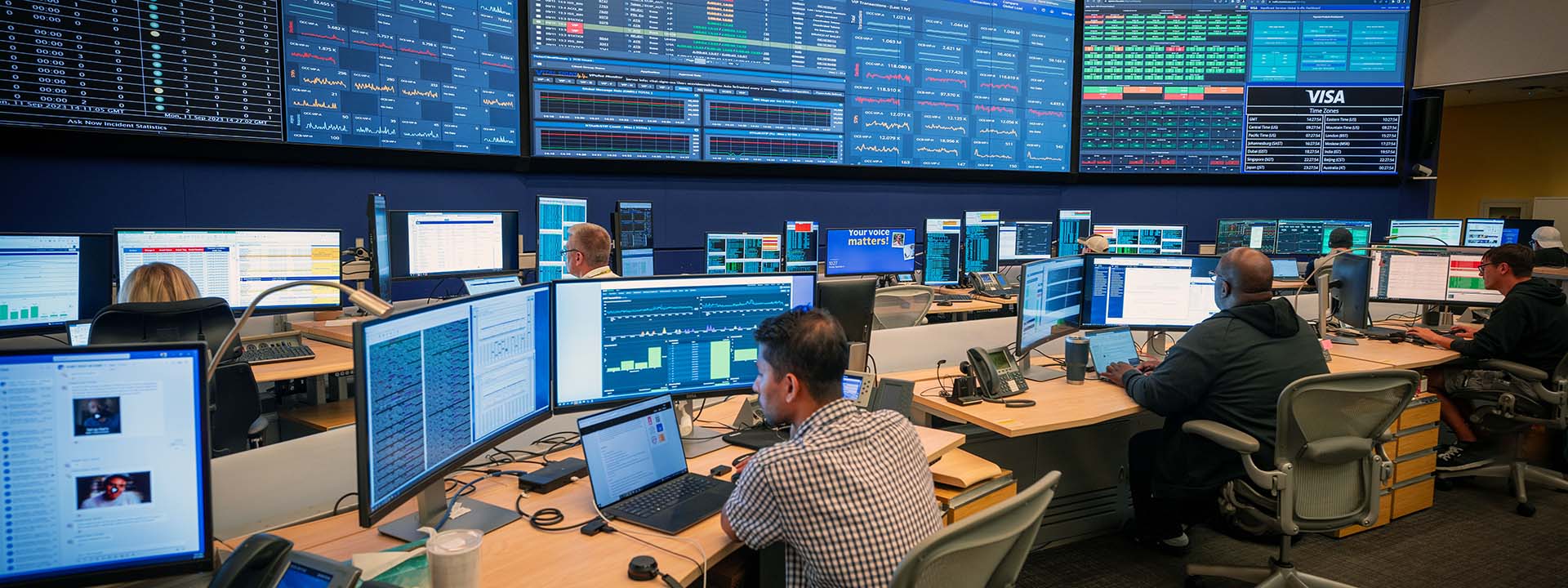
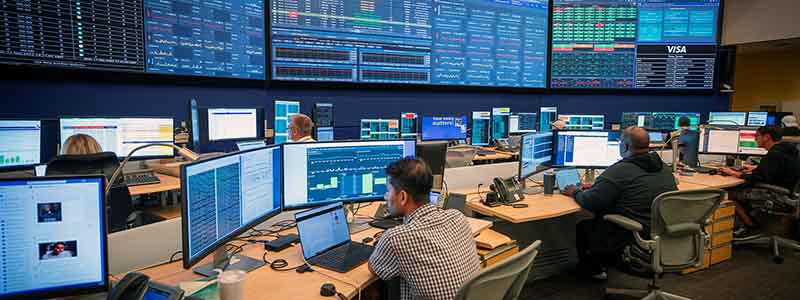
When you pay with Visa, trust is a promise — and an outcome of relentless engineering. Two command centers keep Visa’s network running 24/7:
The Network Operations Center (NOC): Real-time monitoring of every transaction flowing through our system, with stress-test capacity exceeding 65,000 messages per second.
The Risk Operations Center (ROC): A frontline against fraud, processing anomalies in real time and containing attacks within minutes.
Together, they ensure that Visa is always on, always secure, and always trusted.
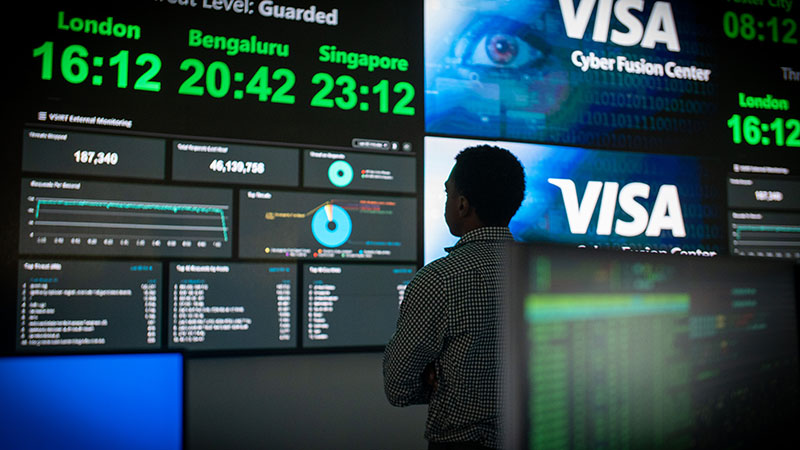
Every day, Ashburn monitors 22 billion security events, triaging up to 100 incidents daily. Our Cyber Fusion Centers, located in Virginia, London, and Singapore, provide round-the-clock global coverage. Even in the event of power outages, natural disasters or cyberattacks, Ashburn’s multi-layered redundancies ensure payments remain uninterrupted.
The foundation for tomorrow’s commerce
Visa’s infrastructure is more than cables, servers and concrete walls — it’s the foundation of global commerce, where trust and ubiquity become reality. From fintech startups to global banks, our partners build on this foundation to scale their businesses worldwide. With continued investment in AI, cybersecurity and infrastructure, Visa delivers not only today’s reliability but tomorrow’s innovation. The future of payments — from agentic commerce to AI-driven transactions to technologies yet to be imagined — will rest on this foundation, enabling growth at every scale. And with that scale comes a global responsibility: to steward the trusted technology that keeps commerce moving worldwide.